Volume: 74 Issue: 4
IUCN Reaffirms Long-Tailed Macaques’ Endangered Status
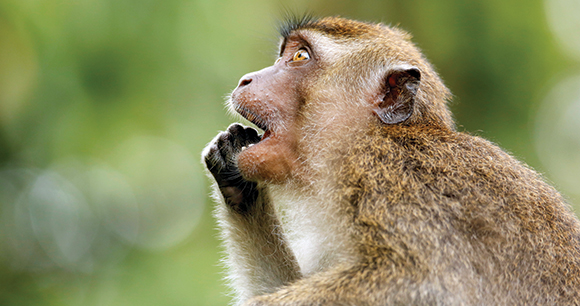
In October, the International Union for Conservation of Nature (IUCN), the global authority on wildlife conservation, officially reaffirmed the “endangered” designation of long-tailed macaques (LTMs)—a monkey species used extensively for biomedical research in the United States—on its Red List of Endangered Species. The IUCN’s decision was based on a scientific assessment conducted by species experts that concluded the global population of LTMs is in steep decline.
The IUCN originally uplisted the species from “vulnerable” to “endangered” in 2022—alarming a biomedical research industry that fears such a designation will encourage tighter restrictions on international trade in LTMs. The following year, the National Association for Biomedical Research (NABR)—the industry’s primary lobbying organization—petitioned the IUCN to return LTMs to “vulnerable” status. While the IUCN did ask for a revised assessment that included updates on LTMs’ global population trends (see AWI Quarterly, fall 2024), this did not alter the outcome.
NABR promptly condemned the IUCN’s final decision, citing two studies to support its claim of “overwhelming scientific evidence” that the species is not at risk. Both studies were funded by NABR and authored by a fisheries and aquatics professor who appears to have conducted little if any prior research on LTM populations (but has a history of publishing industry-funded studies challenging evidence of population declines in fish species).
Notwithstanding the conflict-of-interest issues surrounding NABR’s own counter research, NABR’s response also mentioned another individual’s allegation that the scientific assessment authors “possess conflicts of interest that require further investigation by the IUCN.” The IUCN, however, investigated that allegation and “concluded that there was no evidence of any conflict of interest concerning the people involved in the assessment.”
NABR also claimed that “it is beyond comprehension” that the IUCN could label a species as “endangered” when it has also labeled the species as “invasive” in some countries. Some populations of LTMs are indeed non-native, including in Palau and Mauritius, having been introduced by humans. Yet, as scientists have explained, a species can be “invasive” and “endangered” at the same time—thriving in a non-native area at the expense of species native to that area, even as it faces extinction in its own native range.
NABR is now calling for a reassessment, continuing to emphasize the importance of LTMs for biomedical research. However, special interest in a species—for any purpose—should have no bearing on the purely scientific evaluation of that species’ risk of extinction.
See more AWI Quarterly articles about: Animals in Laboratories, Commercial Trade, Endangered Species, Strengthening Laws, Regulations, and Enforcement, Terrestrial Wildlife
See more AWI Quarterly articles of type: Quick Read