The Captivity Industry
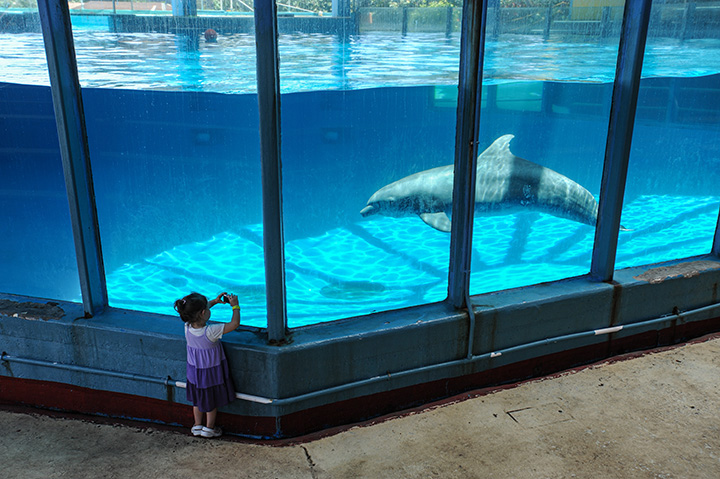
Photo by Jo-Anne McArthur/We Animals
Overview
Cetaceans in captivity experience significant physical and psychological harm, as confinement, performance training, and forced interactions strip them of natural behaviors and social structures. These practices prioritize entertainment over welfare, offering little true educational or conservation value while potentially causing long‑term suffering.
Captive Display of Cetaceans
Over the past decade, the controversy regarding cetaceans in captivity has become more intense, largely due to the 2013 documentary Blackfish and the global effect it has had on a large segment of the general public. Nevertheless, the public display industry continues to insist that people learn important information from seeing live animals in zoos and aquariums. Animal protection groups, and a growing number of scientists, counter that the lives of captive cetaceans are impoverished. In addition, most facilities train cetaceans, particularly bottlenose dolphins, to perform circus-like shows that do not showcase natural behavior. Therefore, visitors do not receive an accurate picture of a cetacean species from captive representatives in tanks or pens.
Captures of cetaceans from the wild are not a thing of the past. Live captures of whales and dolphins continue in hotspot locations around the world, in regions where little is known about the status of populations. Several dolphin species are captured in Japan. Bottlenose dolphins are captured in Cuba. Beluga whales have been captured and traded in Russia since the late 1980s. Orcas also suffered capture and trade in Russia between 2012 and 2018, until a change in the law ended both. The trade in these live-captured animals occurs across the globe and may negatively affect populations and habitats. For smaller cetacean populations, live-capture operations are a conservation concern. Even for those populations not currently under threat, the lack of scientific assessment or regard for welfare makes these operations an issue of global concern.
Cetaceans have evolved to travel large distances daily in a search for food. In captivity, space is constricted for these wide-ranging species and natural feeding and foraging patterns are completely lost. Captive cetaceans are plagued by eye problems, hearing loss, and diseases rarely or never encountered in the wild. Wild-caught cetaceans gradually experience the atrophy of many of their natural behaviors; those associated with dominance, mating, and maternal care are altered in captivity, which can have substantial negative impacts on the animals’ welfare. Captive cetaceans are cut off from the conditions that allow the expression of cultural traits such as specialized vocalizations and unique foraging and hunting techniques. Whatever “enrichment” trainer and visitor interactions provides does not adequately replace the expression of natural behaviors.
Viewing captive animals desensitizes people to inherent suffering—for so many captive cetaceans, the world is a tiny enclosure, and life is devoid of naturalness. Stress-related conditions such as ulcers, behaviors such as circle-swimming and self-mutilation, and abnormal aggression within groups frequently develop in predators denied the opportunity to hunt.
Featured Content
The Case Against Marine Animals in Captivity
Download Report
Swim-With Attractions
Human-cetacean interactions such as swim-with-dolphin encounters and feeding sessions often do not allow the animals to choose the levels of interaction and rest they prefer or need. This can elicit submissive behavior toward humans, which can affect the dominance structure within the animals’ own social groups. Any interaction that allows the public to feed cetaceans puts the animals at risk of ingesting foreign objects.
The many swim-with captive dolphin attractions around the world are very popular and lucrative for the tourism industry. Although it may seem like a fun and harmless way to spend an afternoon while on vacation, it is far from harmless for the dolphin and could be dangerous to humans.
In addition to being captive—possibly having been taken from the wild—and being subject to a multitude of stressors, dolphins in swim-with programs are denied choice and are forced to repeatedly interact with human strangers.
Dolphin swim-with encounters can also be dangerous, since the animals may become stressed and can injure visitors. The dolphins in these attractions are still very much wild animals. Dolphins can also carry potentially dangerous diseases that have been transmitted to humans.
Young females—vital members of the community—are the most sought after because they are less aggressive than males and form the basis for breeding programs. Swim-with attractions are flourishing in vacation resorts in regions such as the Caribbean and the South Pacific, where facilities may be poorly maintained with little regulation or oversight.
Dolphin-Assisted Therapy
Dolphin-assisted therapy (DAT) is a type of swim-with dolphin encounter that is used for people suffering from mental or physical disorders as a form of treatment. DAT proponents foster an unproven belief that there are unique motivational and health benefits to touching and being close to a dolphin, although studies show that such claims are without scientific merit. There is no evidence that DAT is any more therapeutic than other forms of animal-assisted therapy, which are far less expensive for patients and less harmful to animal welfare (as domesticated species are generally used).
DAT sessions can cost thousands of dollars. Many parents of disabled children seek multiple sessions, in an understandable desire to help their loved one at any cost. As a result, DAT facilities are cropping up in many countries, with DAT often used to justify construction of new dolphin facilities, giving an “altruistic” cover to a money-making scheme. This industry thrives on the vulnerability of its patients, and both patients and dolphins are exploited for profit.
Myths & Facts: Captive Display of Cetaceans and their Use in Interactive Encounters
Fact: The dolphin smile is a fixed feature of their anatomy—dolphins smile even when dead. Dolphins and other cetaceans suffer stress and frustration when kept in captivity, particularly when there is no enrichment or when they are housed with incompatible animals. Medications are routinely given to dolphins to treat ulcers and other medical conditions associated with mental and physical stress.
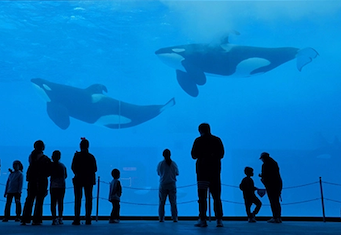
Orcas are inherently unsuited to being held in captivity, due to their ranging habits, size, longevity, intelligence, sociality, and acoustic needs. Orca sociality is complex and family-oriented—when a mother is separated from her calf or when family units are otherwise disrupted, as is common in captivity, the animals experience profound suffering. No tank offers orcas enough space or ever could. Tanks are usually only 100–140 feet long and 25–35 feet deep. In the wild, orcas—which are 6,000–12,000 pounds and 18–24 feet long—can travel 100 miles in a day and dive up to 1,000 feet deep.
Fact: There are no self-sustaining captive populations and animals are needed from the wild to maintain genetic viability. Bottlenose dolphins, orcas, and beluga whales are the only cetaceans who have been bred with some success, but even these do not have self-sustaining captive populations. Also, captive-bred offspring are never returned to the wild, a required step for any breeding program claiming a conservation purpose.
Fact: The education offered at dolphinariums often lacks a discussion of threats facing wild cetaceans beyond “pollution,” as information about threats such as hunting, marine noise, or oil and gas exploration and extraction might offend some people who visit from other countries or who work for the military or certain industries. Certainly, the threat live capture poses to targeted cetacean populations is never discussed.
Claims that captive cetacean performances provide educational benefits to the public and advance conservation science are also false. For example, viewing cetaceans held in concrete tanks that in no way resemble their natural environments, and who are trained to behave in ways that they would not in the wild, does not provide any insight into wild cetacean biology, behavior, or ecological role. If anything, it promotes misinformation about these species. Similarly, scientific research involving captive cetaceans has done little—especially in recent years—to advance scientists’ understanding of cetaceans in the wild. Most of the published scientific research from captive orca facilities addresses captive breeding practices, such as artificial insemination. This research has no conservation benefit, as this technology is used only in captivity.
Fact: Most surveys have shown that the overwhelming majority of patrons of dolphinariums go to be entertained, not educated. The facilities know this and provide entertainment, in the form of shows, tricks, and stunts. They may throw out a few facts and figures (some of which are incorrect or misleading to mask the impact of captivity on these animals) to make people feel good about why they are there, but entertainment is the overriding reason for the existence of these attractions. The type of education that is provided is often misleading—that cetacean capture and/or captivity is acceptable and that tail-walking on water or leaping up to jump through a hoop are natural behaviors.
Fact: The money spent by captive facilities and subsidiary entities on conservation projects is miniscule compared to the profits that are made with dolphin shows, swim-with encounters, and other entertainments. Very few facilities even have conservation programs, and those that do spend only a fraction of their revenue on conservation or stranding responses.
Fact: Cetaceans have evolved to live and die in the ocean and have their place in the marine ecosystem. Meeting and dealing with natural challenges, including finding food, is their “job”—without this job, life for these intelligent animals is at best boring and at worst stressful. Many captive cetaceans—depending on the species—do not live nearly as long as their wild counterparts. Given the threats facing wild cetaceans, such as predators, pollution, and parasites, this raises the question of why these supposedly “protected” animals have similar or worse mortality rates compared to their wild cousins. The answer could be a combination of things—chronic stress, self-harm (such as grinding teeth, which leads to poor health), ingestion of foreign objects, abnormal aggression from other animals, or lack of maternal skill by mothers who were born in captivity themselves. For some cetacean species, mortality rates in captivity are far higher than in the wild. Orcas fare particularly poorly in captivity. The average lifespan of an orca in the wild is 30 years for males and 50 years for females. Of the orcas held in captivity (captive-bred or wild-caught) since 1964, most have died in their teens and 20s; only a handful have survived past 40 years of age, and even fewer have lived into their 50s.
Fact: This argument is often put forth by dolphinariums that have sourced their animals from Japanese dolphin drive hunts. The drive hunts are incredibly brutal—with animals chased, herded, and trapped in bays and coves, and then killed for their meat and other products. About four decades ago, recognizing the rewards to be gained from selling live dolphins to dolphinariums, the drive hunters started allowing these facilities to select some of the trapped dolphins at a price far higher than that of a dead dolphin. It is possible, however, that without the lucrative demand from dolphinariums the drives would have long since been discontinued.
Fact: Whale and dolphin advocates do not want to “shut down” marine theme parks. On the contrary, several marine theme parks have demonstrated for decades that they have many entertaining attractions other than cetaceans to draw tourists to the area. In fact, removing inhumane cetacean shows from their repertoires could broaden the audience of tourists interested in supporting these theme parks. In such a scenario, cetaceans currently held in captivity could be moved to seaside sanctuaries for a dignified retirement. Sanctuaries can provide much-needed space and more natural surroundings, while the animals would continue to receive care from trainers and training for husbandry and veterinary behaviors.
Myths & Facts: Interacting with Whales and Dolphins
Fact: Cetaceans are wild animals, wholly aquatic, with no particular interest in or connection to terrestrial mammals, including humans. Not harming them sometimes means leaving them alone. Interactions with cetaceans in the wild should be minimized and cetaceans do not belong in captivity at all.
Fact: When swimmers enter the water to try to swim with free-ranging cetaceans, this is an added level of invasion of their living space—from two dimensions (on a boat at the water’s surface) to three (in the water with them). The most common activity free-ranging cetaceans are pursuing when swimmers try to swim with them is resting (otherwise human swimmers wouldn’t be able to keep up with them). So swimmers are essentially disturbing their sleep. This can have long-term negative impacts. The only time it is appropriate to swim with whales and dolphins in the wild is when they approach people. If, conversely, people approach them, then the interaction is probably disturbing them.
Fact: In nature, whales and dolphins tend to have complex and stable social bonds—strangers are very rarely encountered. Captive whales and dolphins in normal performance exhibits have relatively long-term, stable bonds with their trainers. However, dolphins in swim-with attractions must interact with many strangers every day. This is not natural and adds additional stress to an already stressful situation.
Take Action for Marine Wildlife

Stop Congress from Gutting the Marine Mammal Protection Act
For over 50 years, the Marine Mammal Protection Act (MMPA) has safeguarded marine mammals from harm, preventing population declines and accelerating their recovery. By aiming to ensure that these animals remain at sustainable levels and continue to play vital roles in their ecosystems, the MMPA has been instrumental in marine conservation. Yet, despite its successes and long-standing bipartisan support, the law faces the most serious threat in its long history—draft legislation that, if enacted, would gut its core protections at a time when marine mammals need them most. Please write your members of Congress and urge them to defend this bedrock law and the remarkable species it protects.
Captive Marine Mammals
Recent News and Articles