Volume: 74 Issue: 4
OSHA Attempts Backflip on Orca Safety Standards
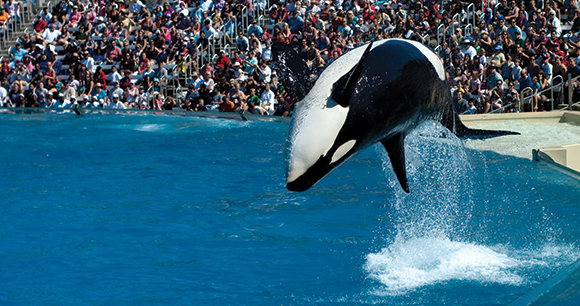
The 2013 documentary Blackfish told the story of Tilikum, an adult male orca who killed his trainer, Dawn Brancheau, in February 2010 at SeaWorld Orlando. In response to this incident, the Occupational Safety and Health Administration (OSHA) cited SeaWorld for a willful violation of the Occupational Safety and Health Act’s “General Duty Clause” (GDC), which requires employers to provide a workplace free from recognized hazards that are likely to cause death or serious harm to employees. SeaWorld’s appeal of the citation resulted in an autumn 2011 hearing before an administrative law judge (ALJ). The Blackfish narrative closes with this hearing, and the film wrapped before the June 2012 ruling was issued.
Although the ALJ reduced the level of citation from “willful” to “serious,” he found that close contact with orcas—including “waterwork” (i.e., swimming in the tank with the orcas during performances)—was a hazard likely to cause death or serious injury that SeaWorld had recognized but allowed to continue. The ruling required protected contact (the standard for training virtually all other dangerous species) for orca training in the future—meaning, among other things, that trainers and animals must be separated by distance or barriers, and waterwork was forbidden.
SeaWorld appealed this ruling as well, engaging Eugene Scalia (son of Supreme Court Justice Antonin Scalia) to argue its case before a three-judge appeals panel in Washington, DC. In SeaWorld of Florida, LLC v. Perez, 748 F.3d 1202 (D.C. Cir. 2014), the panel ruled 2-1 in favor of OSHA. Judge Brett Kavanaugh (whose own appointment to the Supreme Court was still four years away) penned a dissenting opinion that borrowed heavily from the argument Scalia presented in court. Kavanaugh argued that some occupations—such as football, racecar driving, and orca training—are inherently risky, that employees know these risks, and that OSHA inappropriately applies the GDC in cases where such risks cannot be reduced or eliminated without fundamentally altering the nature of the occupation.
Conversely, the majority opinion reasoned that, for occupations without expert oversight of safety (e.g., from professional associations such as the NFL or NASCAR), the GDC is the only protection employees have from recognized workplace hazards. Historically, safety standards for orca training had been set by SeaWorld alone; relevant professional associations—such as the Association of Zoos and Aquariums—had deferred to the company.
Now, 11 years after this victory in court, OSHA is inexplicably proposing a rule to change its interpretation of the GDC to match the dissenting opinion in SeaWorld v. Perez for occupations in the sports and entertainment sector, including marine theme parks. Ordinarily, AWI would not weigh in regarding employee safety issues under the jurisdiction of the Department of Labor. In this case, however, we are submitting comments. We firmly oppose any change to the agency’s interpretation of the law that would open the door for unprotected contact to once again become the norm with orcas. Orcas should no longer be demeaned by performing “death-defying” circus tricks and placed in such proximity to their trainers that they can unintentionally injure or kill them in frustration.
See more AWI Quarterly articles about: Captive Marine Mammals, Marine Wildlife
See more AWI Quarterly articles of type: Feature Article


