Capture and Trade
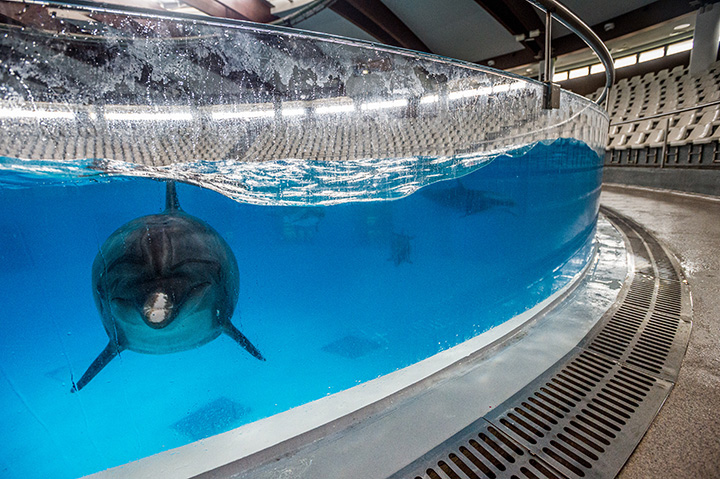
Photo by Jo-Anne McArthur/Born Free Foundation/We Animals
Overview
Capturing and trading in marine wildlife—removing free-ranging wildlife from their natural habitats for human use—occurs globally. Marine wildlife is especially difficult to propagate artificially (that is, to breed in captivity); thus, taking them directly from the ocean is still common. For the most part, these removals are done without adequate environmental assessments to ensure sustainability, and they are rarely done humanely. When moving individuals of various species in trade from their natural homes to buyers and artificial settings, even greater suffering typically ensues.
Take Action: Stop Congress from Gutting the Marine Mammal Protection ActTrade
Trade in marine species—to satisfy our demand for pets, potions, food, ornaments, and entertainment—can be a lucrative business. It can also be a very damaging one. Humans are removing marine wildlife from the oceans at an unsustainable rate, drastically altering marine ecosystems in the process. At the 2010 meeting of the Conference of the Parties to the Convention on International Trade in Endangered Species of Wild Fauna and Flora (CITES), a record number of highly exploited and commercially valuable marine species were proposed for CITES listing in order to provide much needed restrictions on trade. (None of these proposals were approved, despite overwhelming scientific evidence to justify protection.)
Among the more profitable—and unconscionable—trade of marine species is for the marine mammal entertainment industry. Bottlenose dolphins, orcas, and beluga whales (as well as sea lions) are highly sought after, being intelligent and trainable. Profits can be huge for those involved in the capture and trade of cetaceans for dolphinariums. While those capturing the animals might make a few hundred dollars on a sale of a dolphin, those brokering the deals and other middlemen can make many thousands of dollars for show-quality animals, and much more if they have been trained or shown to be fertile.
Once at the dolphinariums, the animals’ origins and the often tragic circumstances that brought them there are hidden from view and far from the minds of the unsuspecting public. Often, these animals were captured from the wild and traded to dolphinariums thousands of miles from their home range. Brutal drive hunts in Japan and Solomon Islands have supplied cetaceans to dolphinariums as far away as China, Turkey, Dubai, Palau, and Mexico. Captures of belugas, and from 2012–2018 of orcas, in the Okhotsk Sea in the Russian Far East have supplied facilities in China, elsewhere in Asia, and Russia itself.
The live cetacean trade is regulated by international conservation agreements. Cetacean species held by dolphinariums are listed on CITES Appendix II—which means exporting countries are required to issue a non-detriment finding (NDF) to ensure that trade will not harm the species in the wild. While CITES has adopted broad standards for NDFs and engages in capacity building to help countries meet their NDF responsibilities, compliance remains questionable at best. Efforts to improve NDF standards have been opposed by CITES-member countries asserting that individual governments should determine their own NDF protocol and procedures. CITES currently does not require NDFs to be provided to importing countries to substantiate the legality of trade. In fact, NDFs do not have to be publicly available at all, or even in writing.
Capture of Cetaceans
Few visitors to dolphinariums (aquariums, theme parks, or tourist attractions with dolphins or other cetaceans used in shows or swim-with encounters) pause to consider where the animals came from. Those who do may believe—or may be falsely told—that they are rescued animals or were born in captivity. Many cetaceans are now born in captivity, but there are regions where this is rarely the case. Captive breeding of cetaceans is difficult, and many whales and dolphins currently in captivity around the world were deliberately captured—not rescued—from the wild. Even for bottlenose dolphins, orcas, and beluga whales—the three species for which there has been some breeding success—self-sustaining breeding populations do not exist, and “new blood” is needed from the wild to supplement gene pools.
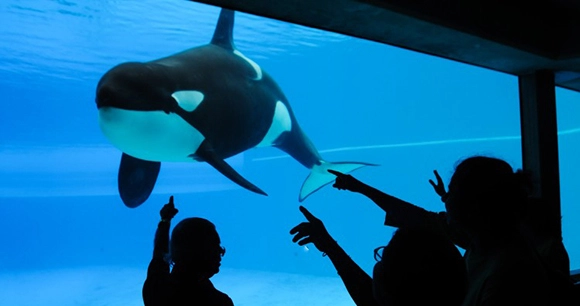
Dolphins and other small cetaceans are still captured from the wild for confinement in dolphinariums; despite what the dolphinariums say, this practice is not a thing of the past. Captures are inhumane and often very violent, with animals routinely injured and killed in the struggle to subdue and separate an animal from his or her family unit. Fear, panic, and flight are natural responses by any animal being hunted, chased, trapped, and roughly handled. The mortality risk for bottlenose dolphins increases six-fold immediately after a capture.
Capture Methods
Various techniques are used to capture cetaceans, depending on the species and the depth of the water. The most popular capture method is by seine net—a large fish net that is positioned vertically in the water column with weights at the bottom and floats at the top. The seine is used in conjunction with a high-speed boat or boats to chase a pod of animals into shallow waters and encircle them with the net. The net is then closed around the animals and pulled very tightly at the bottom, trapping the animals in a “purse.” The animals thrash around and may become entangled or drown. They are then manhandled into slings and hauled on board a capture vessel or herded into shallow sea cages.
Hoop nets are also used to capture dolphins who bow-ride or swim close to boats. A hand-held hoop attached to a breakaway net is lowered over the head and entangles the animal when he or she moves away. The dolphin is then hoisted into the boat.
Featured Content
Small Cetaceans, Big Problems | A Global Review
Resource
Read Report
Probably the most brutal capture method is the drive hunt, whereby pods of animals, once spotted, are chased and driven toward shore using boats and noise. Bays with narrow necks are typically chosen so that once close to shore, a net can be extended across the mouth, cutting off escape. Once confined, the exhausted animals are scrutinized for suitability for captivity while the rest are either butchered for meat and other products, or occasionally freed to an unknown fate.
Holding and Transport
Once captured, animals are held until they can be transported to a final destination. Holding conditions can be very crude and may consist of only a small sea pen or makeshift tank lined with plastic and lacking a proper filtration system. In Russia, there was a permanent sea-pen holding facility near the village of Nakhodka in the Sea of Okhotsk, known as the “whale jail.” It was dismantled only in 2019, after the law was changed in Russia to prohibit orca captures and to establish a moratorium on beluga captures.
Small motorboats are usually used to move animals from the ocean to the shore. For short distances, animals are transported by trucks in slings suspended in water-filled crates or on foam mattresses. For longer distances, animals are kept in slings suspended in water-filled crates that are transported by air. The physiological effects of confining and moving ocean-dwelling animals great distances via ground transport or pressurized airplanes are largely unknown, but the stressful impacts are being documented by an increasing number of studies.
Progress Being Made
There is a growing public awareness that capturing and keeping cetaceans in captivity is inhumane. Many countries have banned live captures in their waters, as well as imports, exports and/or captivity altogether.
Countries that do not allow (or are phasing out) the display of cetaceans for entertainment:
- Bolivia
- Canada
- Chile
- Costa Rica
- Croatia
- Cyprus
- France
- Hungary (achieved through a trade ban)
- India
- Kazakhstan
- Nicaragua
- Slovenia
- Switzerland (achieved through a trade ban)
States, provinces, counties, and municipalities that do not allow (or are phasing out) the display of cetaceans for entertainment:
- Barcelona, Spain
- Mexico City, Mexico
- New South Wales, Australia
- US jurisdictions of California (orcas only), Malibu County, California (all cetaceans), South Carolina, and Maui County, Hawaii.
- Several of these jurisdictions had no dolphinariums to begin with.
Countries that have banned or restricted the trade in live cetaceans:
- Argentina (imports from the Russian Federation prohibited)
- Brazil (ban on imports and exports)
- Chile (prohibits the import and export of dolphins for public display)
- Costa Rica (imports and exports prohibited)
- Cyprus (imports prohibited)
- Dominican Republic (orca imports prohibited)
- Hungary (imports prohibited)
- India (imports prohibited)
- Malaysia (no trade)
- Mexico (trade in wild-caught cetaceans prohibited)
- Solomon Islands (exports prohibited)
- Switzerland (imports prohibited)
- United States (imports of wild-caught cetaceans strictly regulated)
A number of countries (including several of those above) ban or strictly regulate live captures in their exclusive economic zones. Russia prohibited live orca captures (and established a moratorium for beluga captures) in 2018.
In a number of cases, municipal, provincial, and national governments have decided not to allow a dolphinarium or a cetacean exhibit to be built. Furthermore, some countries have implemented strict regulations for the keeping of cetaceans in captivity. Among these are Brazil, Luxembourg, Norway, and the United Kingdom; the United Kingdom used to have as many as 30 dolphinariums and now has none, although they are still legal there. Italy has banned swim-with encounters and other human-dolphin interactions.
Take Action for Marine Wildlife

Stop Congress from Gutting the Marine Mammal Protection Act
For over 50 years, the Marine Mammal Protection Act (MMPA) has safeguarded marine mammals from harm, preventing population declines and accelerating their recovery. By aiming to ensure that these animals remain at sustainable levels and continue to play vital roles in their ecosystems, the MMPA has been instrumental in marine conservation. Yet, despite its successes and long-standing bipartisan support, the law faces the most serious threat in its long history—draft legislation that, if enacted, would gut its core protections at a time when marine mammals need them most. Please write your members of Congress and urge them to defend this bedrock law and the remarkable species it protects.
Captive Marine Mammals
Recent News and Articles