Volume: 73 Issue: 3
Compressed Newspaper as Safe and Suitable Substrate for Naked Mole-rats
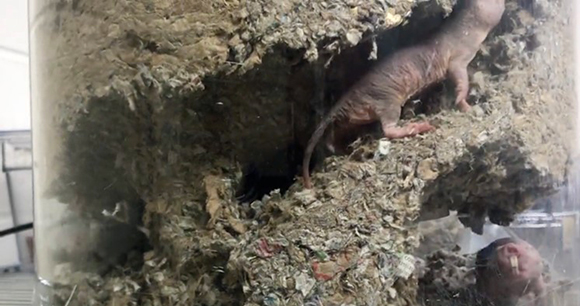
Our project, supported by an AWI Refinement Research Award, focused on evaluating the safety of using compressed waste newspaper as a digging and enrichment substrate for naked mole-rats. These unique fossorial rodents, equipped with ever-growing incisors, create intricate burrows in substrates ranging from sand to hard clay and rock. However, in laboratory facilities, they are often housed on loose cob or chip bedding, creating a mismatch between their natural adaptation and the provided environment. This discrepancy prompted us to explore alternative materials to bridge this gap. Preliminary investigations involved processing newspapers into pulp and shaping them into large columns of compressed newspaper that our naked mole-rats excavated into spiraling tunnels, offering them the choice and control over engineering their own living space.
With the proof of concept established, we wished to assess any potential risks the compressed newspaper might pose to the animals. Samples were collected both before and after a 14-day exposure to naked mole-rats and sent for microbial analysis. Samples included cob (as a control) and blocks of compressed paper in four distinct treatment groups: soaked in reverse osmosis water for two hours (untreated); soaked in bleach for two hours and then rinsed; boiled in reverse osmosis water for two hours; and boiled in a 3 percent NaCl solution for two hours and then rinsed. The analysis found no significant difference in the abundance of bacteria or fungi across the four treatment groups. Furthermore, there were no unique bacterial species in the untreated newspaper that were not present in the unused cob samples; as such, the untreated newspaper isn’t introducing any pathogenic entities that the animals aren’t already exposed to.
To investigate nonliving contaminants, such as heavy metals that may be introduced into the colonies via the newspaper, we also tested samples of newspaper, cob, and reverse osmosis water. This analysis revealed that cob had higher concentrations of copper, magnesium, phosphorus, potassium, sodium, sulfate, and zinc compared to paper, while paper displayed higher levels of sodium than cob. Aluminum and boron were exclusively detected in newspaper, but both were well below levels for concern for traditional laboratory rodents; however, whether naked mole-rats are particularly sensitive to these elements warrants further testing.
We have yet to find any major elements that would be cause for concern in moving forward with using compressed newspaper as a substrate. Compressed newspaper appears to be a safe and sustainable alternative to traditional bedding substrate for naked mole-rats and no more of a risk than using conventional cob bedding.
Jouvay Pantophlet is a registered laboratory animal technician at the College of Staten Island
This study was funded by the AWI Refinement Research Award program. Learn more about this program or to view additional studies.
See more AWI Quarterly articles about: Animals in Laboratories
See more AWI Quarterly articles of type: Feature Article