Volume: 70 Issue: 1
Mice from Labs Have a Field Day… and Lower Anxiety
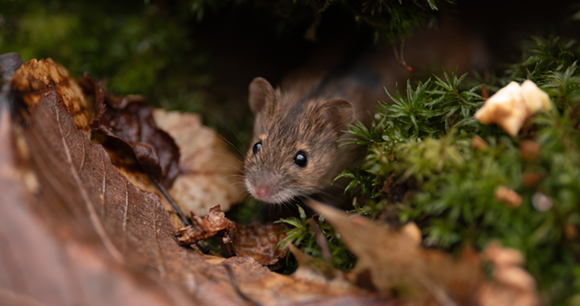
A study in the journal Current Biology (Zipple et al., 2025) has shown that one week of living in nature prevents the development of anxiety or reverses established anxiety in mice who were formerly held in laboratories.
The elevated plus maze is a common laboratory tool to measure rodent anxiety under various conditions. It is used, for example, to assess whether certain drugs affect anxiety in mice. The maze consists of a plus-shaped runway about 20 inches above ground, in which two arms are enclosed and two are open. Rodents are typically fearful of open spaces, but less anxious individuals will spend comparatively more time in the open arms. After the first exposure to the maze, however, all rodents spend dramatically less time in the open arms on subsequent trials—even if they are given an anxiolytic (a drug to decrease anxiety).
In the new study, researchers found that mice who were released into a protected field outdoors did not show the typical decrease in time spent in open arms on subsequent trials. Moreover, mice previously exposed to the maze three times in the laboratory—and who showed the typical decrease in open-arm exploration—reverted to their baseline exploration levels after just one week in the field. These results suggest that living outdoors is more effective against anxiety than anxiolytics in mice held under standard laboratory conditions.
The authors propose that this apparent reduction in anxiety results from mice experiencing more agency (i.e., control over their lives) in the field. In laboratories, mice are typically held in shoebox-sized cages with little or no stimulation. In the field, mice can burrow and forage, make decisions, and respond to challenges. These experiences allow them to face new situations (such as the maze) with confidence rather than anxiety.
According to the study, these results “underscor[e] the risks of inferring general behavioral principles from impoverished housing conditions”—yet more evidence that improving housing conditions in laboratories enhances both animal welfare and scientific validity.
See more AWI Quarterly articles about: Animals in Laboratories
See more AWI Quarterly articles of type: Quick Read