Twenty-Eight Hour Law
Existing Policy
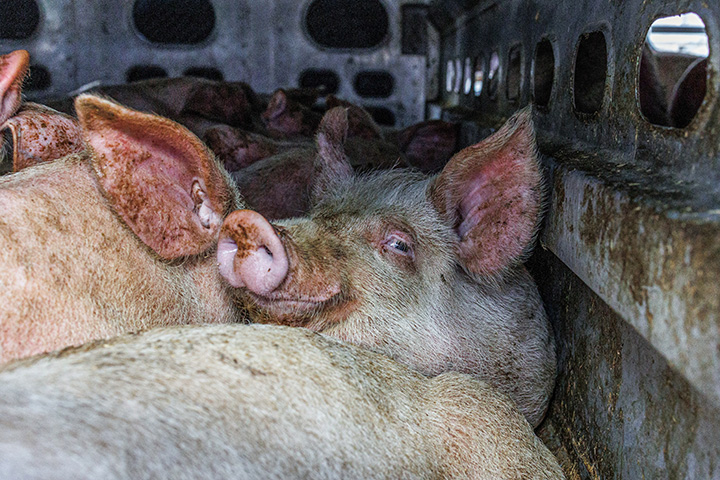
Photo by Wes Burdett/We Animals
Overview
The very first federal animal protection statute—the Twenty-Eight Hour Law—was passed on March 3, 1873, to safeguard farmed animals from excessive suffering during long-distance transport. In its current form, the law prohibits (with some exceptions) confinement of animals for more than 28 consecutive hours without being unloaded for at least five hours for food, water, and rest. It also imposes a duty upon the attorney general to bring a civil action to collect fines of up to $500 for each violation.
Take Action: Help Protect Vulnerable Farmed Animals During Transport!Background
In its current form, the Twenty-Eight Hour Law prohibits (with some exceptions) confinement of animals for more than 28 consecutive hours without being unloaded for at least five hours for food, water, and rest. It also imposes a duty upon the attorney general to bring a civil action to collect fines of up to $500 for each violation.
In 1873, when most farmed animals traveled by rail, the Twenty-Eight Hour Law was a step toward preventing extreme suffering of transported cattle, sheep, and pigs. (The US Department of Agriculture has interpreted the law as not applying to poultry, which are now the most-farmed animals in the United States.) In order to comply with the law, transport companies were obliged to provide facilities at convenient places on their rail lines where feed, water, and rest could be furnished.
Unfortunately, early pens and enclosures provided for this purpose were extremely crude and often sparsely furnished; some were not even equipped with feeding or watering troughs. Few pens offered protection against rain or snow and were often so muddy that animals would not lie down to rest. Too often, the feed was dumped in the mud and animals were forced to drink contaminated water. Additionally, many of the loading and unloading chutes were poorly constructed, which resulted in injury to the animals.
As a result, numerous convictions for noncompliance were obtained before the law was repealed and replaced in 1906 with clearer standards, including a requirement that the loading and unloading of animals be done “humanely.” In 1994, the law was again repealed and reenacted in amended form (but, as stated in the reenacted law, “without substantive changes”).
By the early 1960s, rail cars had increasingly given way to long-haul trucks shipping farmed animals. For the next several decades, however, the USDA’s approach to administering the Twenty-Eight Hour Law did not reflect this shift. In 2003, following a petition and pressure by animal advocacy organizations, the USDA finally clarified via an internal guidance memo that the law applies to trucks as well. Yet the department has never updated its regulations to reflect modern practices.
AWI Documents Inadequate Enforcement
In the decades after the Twenty-Eight Hour Law’s enactment, enforcement was common. After the law was updated in 1906, the USDA reported more than 800 violations a year for 11 consecutive years. As fewer animals were transported via rail, fewer violations were reported—falling to less than 100 a year by 1976. Between 2006 and 2023, the USDA made only 20 inquiries into possible violations of the law, only one of which was referred to the Department of Justice (DOJ), according to an AWI analysis of federal records obtained under the Freedom of Information Act. AWI’s most recent 2025 report on enforcement of the Twenty-Eight Hour Law documents a pattern of widespread noncompliance, delayed investigations, and minimal consequences.
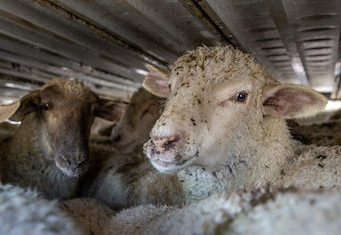
This blatant lack of oversight is alarming, given that millions of animals are transported around the country each year. Records indicate that a significant number of these animals likely undergo journeys in excess of 28 hours without food, water, or rest. In sum, it appears that government agencies have failed to adapt to the modernization of animal transport and have resisted investing in the infrastructure needed to detect and prove violations.
The Twenty-Eight Hour Law appears in the section of the US Code covering transportation, suggesting a potential role for the Department of Transportation (DOT) in its enforcement. Historically, however, the USDA has been the department to investigate compliance with the law, yet it rarely refers evidence of violations to the DOJ.
Two USDA agencies—the Animal and Plant Health Inspection Service (APHIS) and the Food Safety and Inspection Service (FSIS)—play limited roles in detecting violations. The FSIS, which oversees humane handling at federally inspected slaughter establishments, incorporated the Twenty-Eight Hour Law into a directive instructing FSIS personnel to question plant managers about compliance with the law only if animals arriving at the plant appear exhausted or dehydrated.
The APHIS Veterinary Services (VS) program oversees the import and export of animals across US borders. For some exports, such as cattle shipped from the United States to Mexico, VS protocols require transport containers to be sealed at departure and only opened at the destination or, if the trucks are required to stop, at a designated USDA-approved rest station. The seals provide a mechanism to determine whether animals were unloaded during transit. However, for some imports—including all animals sent directly to slaughter from Canada—VS protocols either omit reference to the Twenty-Eight Hour Law entirely or instruct drivers to proceed directly to their destinations without stopping, effectively ignoring the law’s requirements.
Potential Solutions
Currently, the Twenty-Eight Hour Law is the only source of protection—albeit minimal—for animals transported long distances. In truth, comprehensive legislation to address inhumane transport conditions is needed. Short of this, however, steps can be taken to restore some meaning to the existing Twenty-Eight Hour Law. USDA oversight, for instance, should be strengthened. FSIS inspectors should be required to verify compliance more frequently during unloading at slaughter plants. VS should update border protocols to require and verify compliance for all animals entering or exiting the United States. APHIS should standardize documentation, require trip records, and refer all substantiated violations to the DOJ.
Inadequate enforcement of the Twenty-Eight Hour Law, coupled with the continued interstate transport of animals unfit to travel, is contributing to needless animal suffering and endangering the health and safety of millions of animals—and us. Passage of the Humane Transport of Farmed Animals Act would help ensure that animals who are fit to travel are not deprived of basic necessities along the way and that ill or infirm animals are not subjected to grueling journeys that worsen their condition and exacerbate their risk of contracting dangerous diseases.
Take Action for Farmed Animals
Help Protect Vulnerable Farmed Animals During Transport!
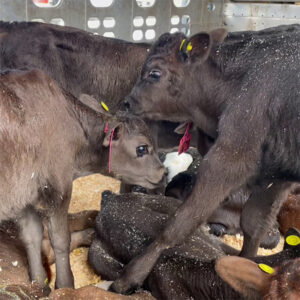
Each year, millions of farmed animals are subjected to long, grueling journeys across the US. Their only source of federal protection from stress and suffering on these trips is the Twenty-Eight Hour Law, which prohibits the transport of certain animals for more than 28 hours without offloading them for food, water, and rest. Unfortunately, the federal government fails to adequately enforce this statute. As a result, many vulnerable farmed animals continue to suffer in packed trucks during cross-country journeys. Please urge your representative to cosponsor the Humane Transport of Farmed Animals Act (H.R. 5286) to increase enforcement of the Twenty-Eight Hour Law and prohibit the transport of vulnerable animals who are unable to withstand long trips.
During Transport
Recent News and Articles