AWI Celebrates 2025 Wins for Animals
December 29, 2025 in All Programs
Washington, DC—With 2025 drawing to a close, the Animal Welfare Institute (AWI) is celebrating some of the year’s most significant steps forward for animal welfare—wins that are making a real difference in the lives of animals in agriculture, commerce, communities, research, and the wild.
The victories highlighted below would not be possible without the steadfast support of advocates across the globe. While 2025 brought uncertainty and unprecedented threats to animal protections, it also illustrated the importance of collective action. Thousands of AWI advocates raised their voices to speak up about key animal welfare legislation and policies in 2025, sending more than 330,000 letters to more than 1,250 legislators and other influential leaders around the globe through AWI’s Action Center. These efforts, combined with our work with coalition partners, contributed to positive outcomes for animals in the US and beyond—reminding us that the collective impact of seemingly small actions can lead to real improvements in the lives of animals.
AWI’s 2025 Wins for Animals (in Chronological order):
Expanded Resources for Those in Need
One of our first major wins for companion animals—and their families—came in March with a significant expansion to AWI’s Safe Havens for Pets directory. Since its launch in 2011, the Safe Havens for Pets website, which includes a directory of pet-friendly sheltering resources for those facing domestic violence, has been accessed tens of thousands of times annually.
This year, in recognition of the significant overlap between domestic violence and homelessness, as well as the growing number of American families facing homelessness, the directory was expanded to include more than 200 sheltering resources across all 50 states for unhoused individuals and their pets.
Additionally, we supplied grants to multiple organizations seeking to expand their safe havens services. One such group is the Humane Rescue Alliance, which recently became the first organization in Washington, DC, to provide support for the pets of those facing homelessness.
A Win for Wildlife in Colorado and Around the World
Despite a challenging federal landscape for wildlife in 2025, we secured victories at the state level. One such win came in June, when Colorado Governor Jared Polis signed S.B. 25-168 into law, making the state a national leader in the fight against wildlife trafficking.
This landmark legislation established criminal penalties for selling, possessing, transporting, importing, or exporting threatened and endangered species found in Colorado, the US, and globally, from the native pronghorn to the giant panda. The law also empowers Colorado Parks and Wildlife to investigate the impacts of wildlife trafficking.
Today, wildlife trafficking is a multibillion-dollar industry. In Colorado, reptiles and amphibians are captured for the pet trade, bobcats are killed for their pelts, and black bears are killed for their gallbladders, which are used in traditional Chinese medicine. Globally, species such as tigers, pangolins, elephants, sharks, and rhinos are routinely killed and their parts harvested for sale, while animals such as parrots, spider monkeys, and reptiles are captured, drugged, and transported to be sold as exotic pets in the US and beyond. Colorado’s new legislation creates positive momentum toward the elimination of these barbarous practices. S.B. 25-168 should serve as a model for other states.
AWI actively worked toward this bill’s passage, and we applaud Colorado’s initiative in moving the world closer to eliminating this brutal, illegal trade.
A Legal Victory for Wild Horses
This year, thousands of wild horses were granted a reprieve from inhumane roundups, thanks to a major legal victory following a lawsuit brought by AWI, American Wild Horse Conservation, Western Watersheds Project, and allies.
In July, the US Court of Appeals for the Tenth Circuit ruled that the Bureau of Land Management had violated federal law by failing to consider a core requirement of the Wild Free-Roaming Horses and Burros Act in its plan to permanently remove wild horses from more than 2 million acres of public lands in Wyoming’s Checkerboard region. The BLM’s plan would likely entail the largest roundup of wild horses in US history, making this an important win that sets a strong precedent for the protection of wild horses across the country.
However, the court’s ruling leaves room for the BLM to revise and potentially reinstate its plan. In 2026, AWI will continue to work to protect wild, companion, and working equines.
A Life Beyond the Lab
Another win for millions of animals occurred this September when, following years of advocacy from AWI and other organizations, the National Institutes of Health announced that its grant funds can now be used for the rehoming and retirement of animals used in laboratories.
The NIH is the largest funder of biomedical research in the world. Prior to this change, the agency’s policy on allowable costs for animals was understood to prohibit the use of funds for post-lab adoption efforts, which contributed to the euthanasia of animals who would have otherwise been good candidates for retirement or rehoming after experiments. Now, these animals will have a better chance at a life beyond the laboratory.
This win may be particularly pertinent going forward, as recent federal initiatives to move toward nonanimal experimentation may increase the need to support post-lab adoption programs.
AWI has advocated better treatment of animals in laboratories since our inception in 1951, and we will continue to work to reduce other barriers to the large-scale retirement of animals from labs, such as negative public perception of certain species or phenotypes and lack of suitable sanctuary space.
Positive Momentum for Pregnant Pigs
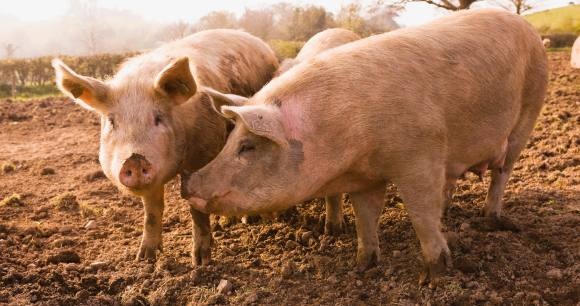
In the United States, most pigs are born on massive factory farms, where pregnant sows are forced to endure confinement in gestation crates that restrict their movement and deprive them of any mental or physical stimulation. However, policy updates earlier this year may signal a coming change.
The American Veterinary Medical Association recently adopted revisions to its housing policy for sows. Previously, the policy explicitly defended the use of gestation crates. This language was removed, and the policy now recommends housing that allows pigs to express “highly motivated behaviors,” though specific examples are not provided. An accompanying resolution noted that the AVMA encourages movement toward group housing, which gives mother pigs more space and allows them to express more natural and social behaviors— improving their welfare.
The AVMA’s positions carry significant weight in the development of federal policy concerning farmed animals, and this update has the potential to result in tangible improvements for the welfare of millions of pigs.
AWI applauds this change, which is a step in the right direction. We look forward to continuing our work in 2026 and beyond to advance the welfare of the billions of animals raised on American farms.
Increased International Protections for Wildlife
In a win for animals across the globe, representatives from 185 nations gathered earlier this month to adopt international trade protections for wildlife at the 20th meeting of the Conference of the Parties to the Convention on International Trade in Endangered Species of Wild Fauna and Flora (CITES) in Uzbekistan.
CITES is a treaty that regulates international trade in the parts, products, and live specimens of thousands of plant and animal species in order to ensure that trade does not threaten species’ survival.
AWI has played an active role in CITES since it came into effect in 1975, and this year was no different. All of the listing proposals we supported were adopted, resulting in protections for the Chilean rose hair tarantula, Dorcas gazelle, two Ethiopian vipers, Ecuadoran marine and land iguanas, and two species of critically endangered African vultures.
These species are impacted by the pet trade, overhunting, climate change, habitat loss, pollution, and/or use in traditional medicines. We look forward to another year of work protecting wildlife impacted by international trade and other human activities in 2026!
Securing Funding to Support Animal Welfare
Each year, US House and Senate committees develop appropriations bills that determine government spending over the next fiscal year. These bills don’t always grab headlines, but they can be an excellent tool for securing funding and initiatives to advance animal welfare.
In 2025, we helped ensure that several provisions benefiting animals were included in fiscal year 2026 appropriations bills and reports:
- Prohibiting the slaughter of wild equines:
Both chambers included language in their versions of Department of the Interior funding bills to protect wild equines from slaughter and lethal control. These long-standing provisions in annual budget bills were hard-won: Thousands of AWI advocates contacted members of Congress urging inclusion of this language after it was omitted from the administration’s proposed budget earlier this year. - Increasing transparency during slaughter:
Agriculture appropriations bills for fiscal year 2026 contain crucial language related to enforcement of the Humane Methods of Slaughter Act, one of the only federal laws aimed at preventing abuse of farmed animals. Additionally, AWI helped secure new language directing the USDA to track verification procedures meant to ensure poultry are handled according to “good commercial practices” in poultry slaughter plants. - Encouraging the use of higher-welfare disease control methods:
AWI has long worked to end the use of cruel “depopulation”—mass killing—methods on factory farms in response to disease outbreaks or other urgent circumstances. This year, our efforts played a key role in the inclusion of appropriations report language directing the USDA to advance higher-welfare methods of depopulation.
In 2026 and beyond, AWI will continue to defend bedrock animal welfare laws from unprecedented attacks and work to pass new policies and legislation to strengthen animal protections. The combined actions of our advocates and members will help us achieve better treatment of animals during the months and years ahead. Please consider making a tax-deductible gift to AWI and signing up for our action alert emails today.
Media Contact Information
Kim Meneo, Animal Welfare Institute
kim@awionline.org, (202) 446-2116
About AWI
The Animal Welfare Institute (awionline.org) is a nonprofit charitable organization founded in 1951 and dedicated to alleviating animal suffering caused by people. We seek to improve the welfare of animals everywhere: in agriculture, in commerce, in our homes and communities, in research, and in the wild. Follow us on Facebook, Instagram, Threads, Bluesky, and LinkedIn for updates and other important animal protection news.