- Dr. Sarah Baert of the University of Guelph for establishing a positive reinforcement training program that allows rats to live in a free-range system and be caught and handled easily.
- Dr. Courtney Glavis-Bloom of the Salk Institute for Biological Studies for purchasing touchscreen computers to promote an enriching environment and measure cognitive decline in marmosets.
- Anna Jimenez and Dr. Marie-Chantal Giroux of McGill University for purchasing transparent handling tunnels as a less-stressful alternative to picking up mice by their tails.
- Dr. Kathy Lapointe of the University of Montreal for developing and implementing a physical therapy program to reduce muscle atrophy and increase psychological stimulation among cats, dogs, and horses used for teaching at the university’s veterinary school.
- Rochelle Moore of the University of Utah for purchasing a 3D printer to print custom caps that cover and protect cranial implants and surrounding tissue in rhesus macaques.
- Dr. Catherine Schuppli of the University of British Columbia for purchasing larger cages and enrichment activities for rats and mice to engage in burrowing, climbing, and exploration.
AWI Implementing Refinement Grant
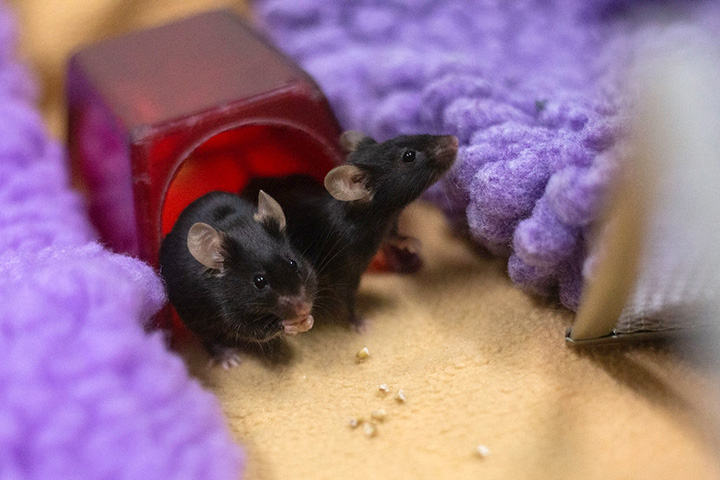
Photo by Lexis Ly
Supporting the Implementation of Refinements to Improve the Welfare of Animals Used in Experimentation
AWI offers grants of up to US$8,000 toward the implementation of a refinement (e.g., purchase of equipment or staff training) that will improve the welfare of animals used in experimentation.
The application is not open at this time. Preview Form
Dates and Deadlines
- The 2026 application cycle will open later this year (typically from mid-August until mid-October).
- Awardees are selected and notified in December.
If you wish to be notified via email when the 2026 application cycle opens, please contact us at implementationgrant@awionline.org. You may remove yourself from the list at any time.
How To Apply
Use our online system to complete and submit the application form. The application requires the following documents:
- Detailed proposal
- Proposed budget and details
- Curriculum vitae (CV) or resume
- Letter of support from the host institution
Eligibility
- This award is open to residents of the United States or Canada, and the project must be conducted in the United States or Canada.
- Animal care staff, veterinarians, students, and researchers are welcome to apply.
- Applicants can apply every year and will be equally eligible for funding even if they have received funding in previous years. Projects that were submitted but not selected for funding in previous years can be resubmitted.
- Applicants may submit more than one application per funding cycle, and AWI may consider, at its discretion, funding a second project by the same applicant if, during that cycle, funds remain after all worthy projects from other applicants have been funded. In most cases, however, AWI will fund no more than one project (through either an Implementing Refinement Grant or a Refinement Research Award) per applicant per funding cycle.
- James Sheehy, animal facilities supervisor, IIT Research Institute, to purchase and install stainless steel vertical socialization tunnels for the institute’s colony of long-tailed macaques, doubling their living space and adding vertical complexity.
- Dr. Wai Hanson, senior clinical veterinarian and assistant professor, Emory University, to purchase and install high-quality images of gravel—designed to mimic natural substrate—beneath 780 tanks housing some 13,000 zebrafish across two facilities. This simple, easy-to-implement refinement has been shown to reduce zebrafish stress levels.
- Lillian Basom, director of operations, Franklin and Marshall College Vivarium, to improve the facility’s rat housing, resulting in a fivefold increase in the current living space, enhancing its complexity and promoting the expression of natural behaviors such as climbing, upright standing, and play.
- Cecily Burbidge, animal care and welfare supervisor, University of Calgary Faculty of Veterinary Medicine, to purchase high-quality nesting boxes and provide increased opportunities for exercise and enrichment for the institution’s colony of woodchucks.
- Dr. Julia Goldman, clinical veterinarian at the Baylor College of Medicine, and Dr. Jennifer Mitchell, associate professor at the University of Texas MD Anderson Cancer Center, to purchase tunnels for handling mice. Tunnel handling is proven to be a more humane and less stressful alternative to the traditional practice of picking up mice by their tails.
- Dr. Diana Coulon of Pennington Biomedical Research Center to purchase materials that allow rodents to climb and perch, encouraging species-specific behaviors and providing new places to explore and hide.
- Ioan Cozma of the Research Institute of the McGill University Health Centre to purchase tree branches for marmoset cages to promote natural wood-gnawing behaviors.
- Joshua Ejdelman of the Research Institute of the McGill University Health Centre to purchase quieter and lower-vibration wheels for carts to reduce animal stress as they are transported within facilities.
- Tania Liboiron of the University of Saskatchewan to purchase large, double-decker cages with interlinking tubes and enrichment tools, such as activity wheels and huts, to offer rats social housing without overcrowding.
- Dr. Kerith Luchins of the University of Chicago to purchase handling tunnels for mice and expand their use campus-wide to reduce animal anxiety and improve welfare.
- Dr. Carly Moody of the University of California, Davis to purchase elevated platforms and shelters for mice and create educational infographics about the benefits of these enrichment items.
- Dr. Vanessa Oliver of the University of Calgary to purchase pens, toys, and shelters to implement an exercise program for rabbits institution-wide that will improve their physical and mental health.
- Jenna Owens of Texas Biomedical Research Institute to build cooperative enrichment items for singly housed primates, including tug-of-war units, puzzle feeders, and interactive touchscreen tablets, to encourage social interaction and play between animals housed next to each other.